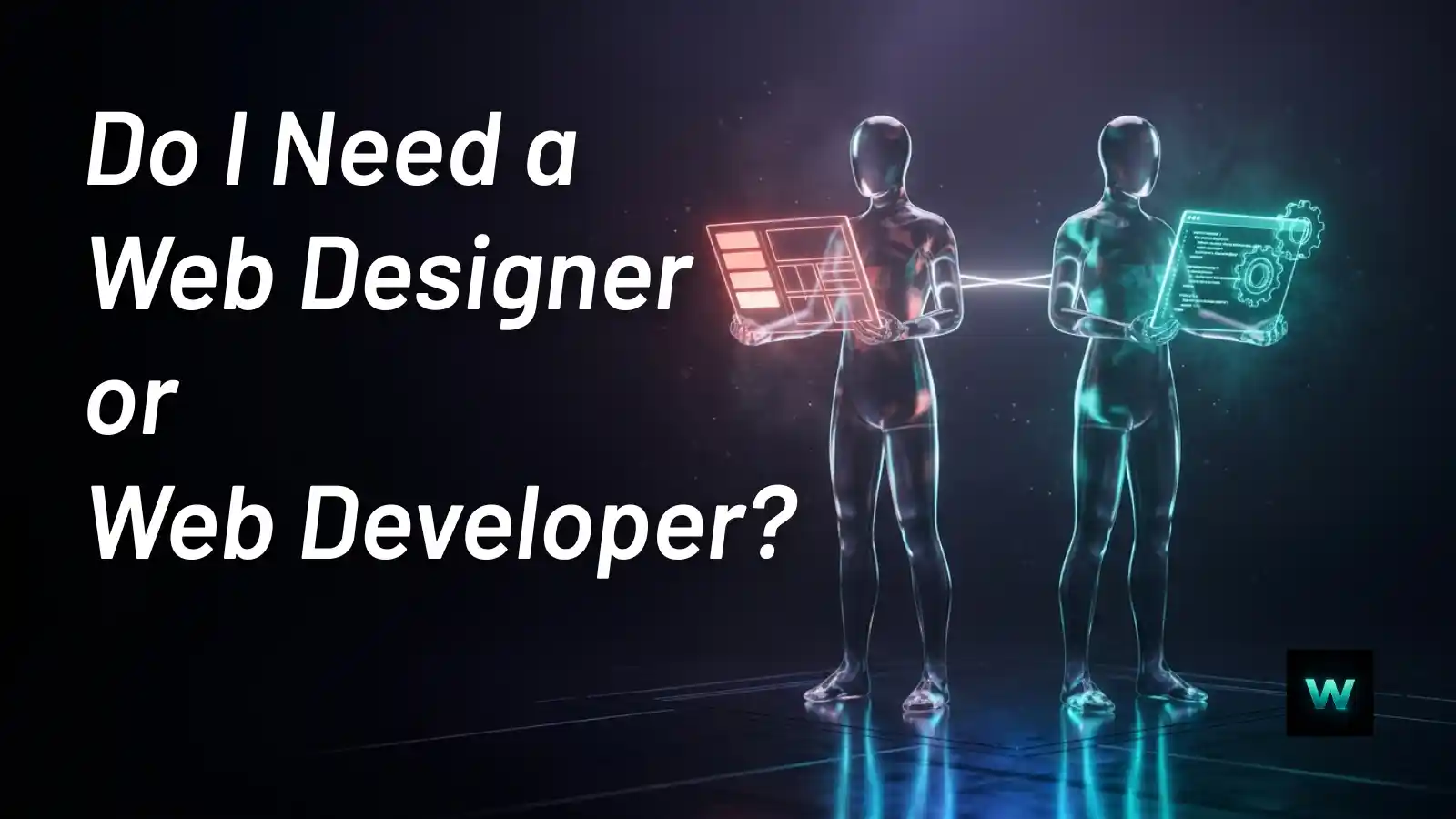
Do I Need a Web Designer or Developer?
Most business websites need both design and development – they’re different disciplines that work together. A designer determines how your site looks, feels, and guides users. A developer determines how it works – the code, the database, the integrations, and the performance under the hood.
If your project is primarily visual (refreshing the look, improving layouts, updating branding), you need a designer. If your project is primarily functional (adding integrations, building user accounts, fixing performance, connecting APIs), you need a developer. If you’re building or rebuilding a website from scratch, you need both.
This guide is written for business owners making a hiring decision – not developers choosing a career path. It covers:
- What designers and developers actually do (in plain business terms)
- Which one your specific project needs
- When to hire a freelancer vs an agency
- What AI tools can and can’t replace in 2026
- Red flags to watch for before signing a contract
For the full picture on what custom development involves, see our custom website development guide.
What Does a Web Designer Actually Do?
A web designer is responsible for everything a visitor sees and experiences when they land on your site. Their job is to make your website visually compelling, easy to navigate, and structured so visitors take the actions your business needs them to take.
Specifically, a web designer handles:
Visual design – the layout, color palette, typography, imagery, and overall aesthetic that makes your site look professional and on-brand. This is what creates (or kills) first impressions in the first 3 seconds.
User experience (UX) – the flow of how visitors move through your site. Where do they land? What do they see first? How do they get from the homepage to the contact form? A good designer maps this journey intentionally, not randomly.
Responsive layouts – ensuring the design works on desktop, tablet, and mobile. This isn’t just shrinking the desktop version. Mobile design has different constraints (thumb-friendly tap targets, limited screen space, different reading patterns) that require deliberate choices.
Wireframes and prototypes – before any code is written, designers create visual blueprints of each page. These show the structure and content hierarchy without final colors or images, letting you approve the skeleton before the skin goes on.
What a designer does NOT do: write back-end code, set up databases, configure servers, build API integrations, or handle technical SEO at the code level. Those are development tasks. A designer who promises to handle everything is either a full-stack generalist (rare and valuable) or over-promising (common and expensive).
What Does a Web Developer Actually Do?
A web developer turns designs into a working website. They write the code that makes everything function – from the navigation menu to the contact form to the checkout process. If the designer builds the blueprint, the developer builds the house.
There are three types of developers, and knowing the difference helps you hire correctly:
Front-end developer – builds what visitors see and interact with. They translate the designer’s mockups into working HTML, CSS, and JavaScript. If something animates, responds to a click, or adapts to a screen size, a front-end developer made it happen.
Back-end developer – builds what happens behind the scenes. Databases, server configuration, user authentication, payment processing, API connections, email triggers, and data management. When a visitor submits a contact form and it arrives in your inbox – that’s back-end development.
Full-stack developer – handles both front-end and back-end. Full-stack developers are the most versatile hire for small-to-mid projects because one person owns the entire build. For larger or more complex projects, specialized front-end and back-end developers working together produce better results.
What a developer does NOT do (typically): create the visual design from scratch, make branding decisions, or determine the user experience strategy. Developers can implement a design brilliantly, but asking a developer to also create the design is like asking an architect to also be the interior decorator. Some can do both. Most are stronger at one.
For context on how different tech stacks impact what developers you need, see our stack comparison guide.
Which One Does Your Project Need?
Here’s a scenario-based framework. Find the situation closest to yours:
Scenario 1: “My website works fine technically but looks outdated.”
You need: A designer. The architecture is sound – you just need a visual refresh, updated branding, and improved layouts. If the CMS and hosting are stable, a designer can update the look without rebuilding the engine. This is a redesign, not a rebuild. See our redesign vs rebuild framework for more context.
Scenario 2: “I need a brand new website from scratch.”
You need: Both. Design comes first (wireframes, visual direction, UX flow), then development brings it to life in code. Hiring them separately is possible but risky – the handoff between a designer and developer who’ve never worked together is where projects fall apart. An agency that does both under one roof eliminates this gap.
Scenario 3: “My website looks fine but it’s slow, breaks on mobile, or can’t connect to my CRM.”
You need: A developer. These are technical problems that no amount of design work can solve. A developer diagnoses performance issues, fixes mobile responsiveness at the code level, and builds the integrations your business needs.
Scenario 4: “I’m building an e-commerce store / SaaS marketing site / LMS platform.”
You need: Both, ideally from a team with experience in your specific project type. A generic designer and a generic developer will build you a generic result. Specialized teams understand the conversion patterns, technical requirements, and UX conventions specific to e-commerce, SaaS, or LMS – and they build faster because they’re not learning on your project.
Scenario 5: “I just need a simple 3-5 page site to get online fast.”
You need: A full-stack freelancer or a designer who works with WordPress/Squarespace. For simple sites, one person can handle design and implementation using a CMS with minimal custom development.
Scenario 6: “My website exists but isn’t generating any leads.”
You need: A strategist first, then possibly a designer. The problem might be messaging, CTA placement, trust signals, or user flow – not the code. Start with a conversion audit before hiring anyone to rebuild. Check our warning signs your website is losing clients to diagnose whether the issue is design, development, or strategy.
Freelancer vs Agency: Which Should You Hire?
This decision depends on project complexity, budget, and how much oversight you want to handle yourself.
Hire a freelance designer when: you need a visual refresh, a new landing page, or branding updates. The scope is clear, the timeline is short (2-4 weeks), and the budget is under $5,000. You’re comfortable managing the project yourself and providing detailed feedback.
Hire a freelance developer when: you need specific technical work – fixing bugs, adding integrations, improving speed, or building a custom feature on an existing site. The scope is technical and well-defined.
Hire an agency when: you need strategy, design, and development as an integrated process. The project involves both how the site looks AND how it works. The budget is $5,000+ and you want a structured process with project management, QA, and post-launch support so you’re not managing everything yourself.
The handoff problem: the biggest risk in hiring separately is the gap between design and development. A designer creates a beautiful mockup. A developer receives the mockup and says, “This animation will add 3 seconds of load time” or “This layout can’t work in the CMS you’re using.” Now you’re mediating between two freelancers who have different priorities and no shared accountability.
Agencies solve this by keeping design and development under one roof. The designer understands the developer’s constraints. The developer understands the designer’s intent. The result is a site that looks great AND performs – because the people building it were aligned from day one.
Webezio handles both design and development as an integrated full-service website development process. One team, one workflow, one point of accountability.
What About AI Website Builders in 2026?
AI tools like Framer AI, Durable, 10Web, and WordPress AI assistants can generate functional websites in minutes. So do you still need a human designer or developer?
What AI tools do well: generate initial layouts, suggest color schemes, write placeholder copy, create basic responsive pages, and produce a “good enough” site for someone who needs something live today with zero budget.
What AI tools cannot do: understand your business strategy, map a conversion funnel based on your target audience’s psychology, build custom integrations with your CRM or payment systems, optimize for technical SEO and AI search visibility, or create a visual identity that differentiates you from every other business using the same AI tool.
The result of an AI-generated website is a site that looks like every other AI-generated website. For a personal blog or a one-page landing page, that’s fine. For a business where the website is a revenue channel – where visitors become leads become clients – an AI-generated site is a starting point at best.
The practical use of AI in professional web projects: AI is a tool for designers and developers, not a replacement. Designers use AI to generate initial concepts faster. Developers use AI coding assistants to write boilerplate code faster. The human expertise is in the strategy, the decisions, and the quality control – not the production speed.
If your website directly generates revenue (e-commerce), captures leads (service business), or represents your brand to enterprise buyers (B2B), AI tools alone won’t get you there. You need human strategy layered on top.
How Much Does It Cost to Hire a Designer or Developer?
Cost varies significantly by who you hire, where they’re located, and the scope of work. Here’s what’s realistic in 2026:
Freelance web designer: $30-$100/hour (US/UK/AU). A homepage redesign might cost $1,500-$5,000. A full website design (5-15 pages with wireframes, prototypes, and responsive layouts) runs $3,000-$12,000.
Freelance web developer: $40-$150/hour (US/UK/AU). A WordPress build from an existing design runs $2,000-$8,000. A custom React or Next.js build runs $8,000-$25,000+. Bug fixes and integrations are typically billed hourly at $500-$2,000 per task.
Full-service agency (design + development): $5,000-$50,000+ per project depending on complexity. This includes strategy, design, development, testing, launch, and often post-launch support. Higher upfront cost, lower risk, and a complete deliverable.
The cost difference between a freelancer and an agency isn’t just about price – it’s about what’s included. A freelancer quotes design or development. An agency quotes a complete solution: strategy, design, development, SEO foundation, QA, training, and support. Comparing a $4,000 freelancer quote to a $15,000 agency quote is comparing two different products.
For detailed pricing by project type, see what custom websites cost.
Red Flags When Hiring a Web Professional
Whether you hire a freelancer or an agency, these red flags apply universally. Walk away if you see any of them.
No live portfolio. If they can only show mockups, PDFs, or “concept designs” but no live websites you can click through, they either haven’t built real projects or the projects they built didn’t survive contact with reality.
No defined process. A professional who can’t walk you through their process from kickoff to launch (discovery, design, development, testing, launch) is winging it. Your project will suffer from scope creep, missed deadlines, and miscommunication.
They don’t ask about your business goals. A designer or developer who jumps straight to “what colors do you like?” without asking what the website needs to achieve for your business is building decoration, not a business tool. The first conversation should be about your audience, your goals, your conversion targets, and your competitive landscape.
Fixed price without understanding scope. A quote of “$3,000 for a website” before any conversation about requirements means the price is arbitrary. It’s either too low (and they’ll cut corners) or too high (and they’re banking on your lack of knowledge). Legitimate quotes come after scope is defined.
No post-launch support plan. The day your site launches is the day it starts needing updates, security patches, and content changes. If your web professional disappears after launch, you’ll need to find someone new to maintain a codebase they didn’t build – which always costs more. Ask about ongoing maintenance plans before you sign.
They own your domain or hosting. You should always own your domain registration and hosting account. If the agency controls these, you’re locked in. If the relationship ends, reclaiming your assets becomes a negotiation instead of a transfer.
How to Choose the Right Web Design Company
If you’ve decided to hire an agency, here’s how to evaluate them beyond the portfolio page.
Check their own website first. An agency’s website is their best work and their strongest advertisement. If their own site is slow, poorly structured, hard to navigate on mobile, or looks like a template – that tells you exactly what your project will look like.
Look for projects similar to yours. A portfolio full of restaurant websites doesn’t prove they can build a SaaS marketing site. Look for case studies in your industry or project type. If they’ve built e-commerce stores, look at the checkout flow. If they’ve built service business sites, check whether the conversion path is clear.
Ask about their tech stack. A good agency works across multiple platforms (WordPress, React, Next.js, Laravel, Shopify) and recommends the right one for your project. An agency that only builds on one platform will recommend that platform regardless of fit.
Test their communication before signing. How quickly do they respond? How clearly do they explain technical concepts? Do they ask smart questions about your business? The way they communicate during the sales process is the best version of their communication. If it’s slow or unclear now, it will be worse mid-project.
Ask for a scope document before a contract. A professional agency provides a written scope of work that details every deliverable, every milestone, and every assumption. If they want to start work before scope is documented, the project will have scope creep – guaranteed.
Verify ownership terms. You should own everything – the code, the design files, the content, the domain, and the hosting account. If the contract says the agency retains ownership of any deliverables, negotiate or walk.
What Happens After Launch?
The biggest mistake business owners make is treating a website as a one-time project. A website is a living business asset that needs ongoing attention – the same way a physical storefront needs maintenance, inventory updates, and seasonal refreshes.
After launch, your website needs:
Security updates – CMS core updates, plugin patches, and server-level security. An unpatched WordPress site is a target for automated attacks. According to Sucuri, 96% of infected CMS sites in their 2024 report were WordPress – almost entirely due to outdated plugins and themes, not WordPress itself.
Performance monitoring – page speed can degrade as content grows, plugins are added, and hosting resources shift. Monthly speed checks prevent gradual slowdowns that hurt rankings and conversions.
Content updates – new services, updated pricing, fresh blog posts, new portfolio entries. Stale content signals to both visitors and search engines that the business may not be active.
SEO maintenance – keyword monitoring, crawl error fixes, internal link updates when new pages are added, schema adjustments as the site evolves.
Webezio’s ongoing maintenance plans cover all of this at a fixed monthly rate – so you’re not paying hourly for updates and wondering whether the invoice will be $200 or $2,000.
Frequently Asked Questions
What is the difference between a web designer and a web developer?
A web designer handles the visual layer – layout, colors, typography, user experience, and responsive design. A web developer handles the functional layer – code, database, server configuration, integrations, and performance. Designers determine how the site looks and feels. Developers determine how it works. Most business websites require both disciplines working together.
Can one person do both web design and development?
Yes – they’re called full-stack developers or designer-developers. They’re ideal for smaller projects (5-10 pages, limited custom functionality) where one person can manage the entire build. For complex projects with custom integrations, advanced UX requirements, or enterprise-scale architecture, specialized designers and developers working as a team deliver better results than one generalist.
Should I hire a freelancer or an agency for my website?
Hire a freelancer for well-defined, single-discipline tasks under $5,000 – a visual redesign, specific bug fixes, or a custom feature addition. Hire an agency for projects that require strategy, design, and development as an integrated process – new website builds, platform migrations, or any project where the site needs to generate measurable business results. The deciding factor: if you’re comfortable managing the project yourself, a freelancer works. If you want someone to own the process end-to-end, an agency is the better investment.
How do I know if my project needs a developer or just a designer?
Ask yourself one question: is the problem visual or technical? If visitors aren’t engaging because the site looks dated, the messaging is unclear, or the layout confuses them – that’s a design problem. If the site is slow, breaks on mobile, can’t connect to your tools, or has functional errors – that’s a development problem. If you’re building something new from scratch – you need both.
Can AI replace web designers and developers in 2026?
Not for business websites that generate revenue or capture leads. AI tools can produce functional starter sites quickly, but they can’t develop a conversion strategy for your specific audience, build custom integrations, optimize for technical SEO and AI search engines, or create a brand identity that differentiates you from competitors using the same AI tools. AI accelerates production – it doesn’t replace the strategic thinking that makes a website effective.
Skip the Guesswork
You don’t need to figure out whether your project needs a designer, a developer, or both. That’s our job. Tell us what you’re trying to achieve, and we’ll tell you exactly what the project requires, which skills are needed, and what it costs. No jargon. No unnecessary upsells. Just an honest assessment and a clear plan.